“Hussshhhh!!”
There is a certain kind of silence every parent recognizes. Most of the time, it’s suspicious. It means the toddler has wandered somewhere they shouldn’t, or the teenager has suddenly become too quiet. But there is another kind of silence, softer, almost fragile. It’s the silence of a child who has forgotten the world around them because a story has completely hooked him.
That is the silence we are seeking at AlifLaila.
Not so long ago, moments like that were becoming difficult to come by. Children still had books in their schools and stories at home, but the screens in their hands had begun to tell a different story. One tablet would start blinking, then a video would begin, and, before the initial one was even finished, another one would emerge afterwards. And the screen continued to move, and the child did not remember very much that was left to him.
A simple question that came to our mind in response to that pattern was. If kids are already spending so much time on digital devices, wouldn’t it be possible for those same devices to point kids back to reading rather than putting them further away from reading?
It is this question that served as the foundation of the AlifLaila Digital Kids Library.
We didn’t begin with a promise. We began with a test.
Before And After AlifLaila
Over 2,000 children from various schools and ages came to know the AlifLaila digital kids library during our internal pilot. Some of them were students of the busy classrooms of Lahore. Some were learning in small schools in such locations as Bhalwal and Okara.
The one thing they all had in common was the experiment: another tablet or phone that did not lead to a video feed, but to a shelf of illustrated stories.
The change was not noticeable at the beginning. A small selection of children came out of curiosity. Some attempted to open badges or take quizzes attached to the stories. Teachers observed that students were starting to compare reading levels as they used to compare their game scores.
And then something even more unexpected began to happen.
Children kept coming back.
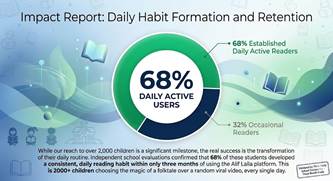
In three months, the platform data indicated that 68% of the students had developed their regular daily reading habit. Rather than the opening of random videos post-school, many of them were the opening of a story.
At Muqabbir School, one of the teachers told us something unexpected. The students started to complete their assignment earlier, in order to gain some more time to read. It was the first time a digital reading process was something children desired rather than something they were required to do.
What Happened During the Holidays?
Teachers know something most often referred to as the holiday slide. When schools go on holiday (summer or winter break), the reading practice that students had been making regular throughout the term tends to vanish. Without daily reminders or classroom routines, books are usually the one thing that will be gone.
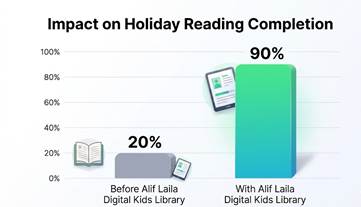
Schools that have piloted the AlifLaila digital kids library reported that before the AlifLaila, only an estimated 20% of students did their holiday reading work regularly.
The pilot transformed that trend by a great deal.
Because the digital library enabled teachers and parents to track reading progress in real time, students kept reading stories even when they were out of school. Progress badges, reading levels, and small rewards kept them quiet and engaged.
During the last holiday break, the platform helped almost 90% of participating students to meet their reading objectives.
The change was striking. The break that had interrupted reading had begun to reinforce it.
Creating a Library Where None Exists.
In most schools, motivation is not the most daunting issue; it is access.
To construct a classic library, one must have a place, shelves, thousands of books, and a full-time librarian in most cases. Those resources are plainly unavailable in many schools of Punjab in the public sector.
This is the area where the digital model opens another door.
With the AlifLaila platform, schools are able to offer students a digital library in multiple languages at a mere cost of 20 PKR per student. In the case of a school of 500 students, an amount of approximately 10,000 PKR on a monthly basis can open a library with illustrated stories, reading levels, and interactive learning resources. This is less than the monthly wage of a single staff member.
Students no longer have to wait years before a physical library can be constructed; they can just access stories that accompany them anywhere they go on the devices they carry with them.
That change could be transformational to schools whose bookshelves used to be very limited in number.
When the Numbers Start to Speak
- 2,000+ children reached across multiple schools
- 68% of students are now reading daily
- Holiday reading participation rising from 20% to nearly 90%
But statistics do not make the complete picture.
In the background of such figures are classes where pupils are already browsing digital pages rather than hopping between videos. Now, there are teachers who monitor reading progress with the help of dashboards instead of speculating who completed their tasks. And some children are finding the stories that sound like the languages that they are hearing at home.
To put it another way, those figures were indicating something much bigger than an app.
They are talking about the change of the interface children have on the screens that encompass them.
Somewhere tonight, another child will open a tablet and swipe to the next page of a story. The room will grow quiet for a while, not because something is wrong, but because imagination has taken over.
And that kind of silence tells the best story of all.