Let’s create a picture.
Ayesha is eight and she sits on a colored rug in her living room in a cross-legged position. She holds a tablet which illuminates her face. In the majority of cases, this screen implies cartoons, loud videos, or continuous scrolling.
But today is different.
Today, the same thing is not happening.
Today, Ayesha is reading.
She scans the page of a Punjabi storybook, which her grandmother reads to her before their bedtime, with her finger. The characters are recognisable. The words sound like home. And somehow this little screen has turned out to be a storybook.
These may be small or insignificant scenes, but they address a bigger picture: technology does not necessarily need to separate children from their traditions. As a matter of fact, it can even lead them directly into them.
The Crisis
The children in the current generation are being exposed to electronic devices. They understand how to operate such devices even before learning how to read. And by the time they enter school, most of them are already knowledgeable about how to use apps like YouTube and videos.
The issue is that, although devices are everywhere, good and meaningful reading materials about kids, particularly in regional languages, cannot be found anywhere. These children were brought up in families that speak Urdu, Punjabi, Sindhi, Pashto, etc., and once they enter the internet, they are brought to another thing known as the content desert. In this region, children are exposed to unlimited entertainment but very limited good content in local languages.
The AlifLaila Theory of Change
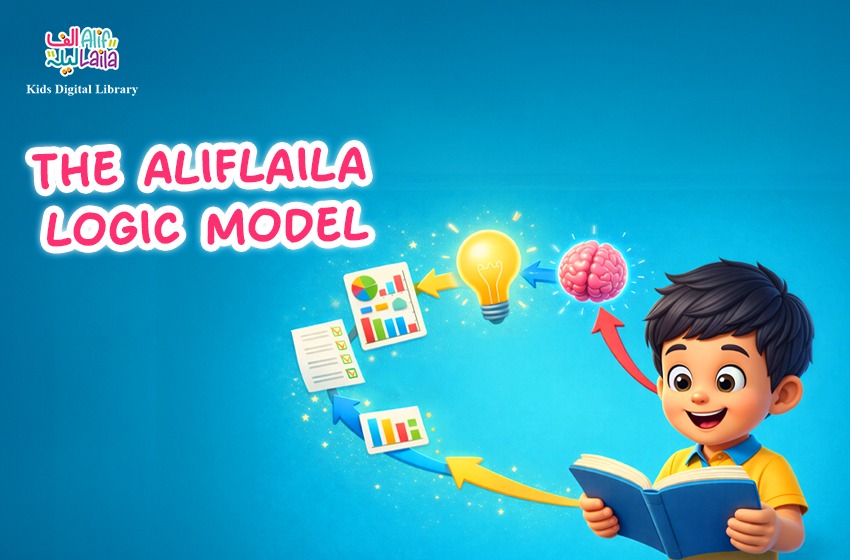
The AlifLaila Digital Kids Library is an initiative that was created in order to address this particular issue. Its methodology is based on a simple yet potent logic model that aims at turning screen time into reading time.
Step 1: Strategic Access
Instead of removing books offline, this platform only caters to the already existing level of children through tablets and phones. AlifLaila digital kids’ library has the advantage of enabling children to access it anywhere, anytime, without the restriction that physical books have.
Step 2: Cultural Resonance
The library has depicted excellent stories in Urdu, English, and Arabic. For example, when children read in a familiar language, and they can see characters and settings that resemble their own world, stories immediately get more interesting. In this way, they will become more motivated to read.
Step 3: Interactive Dynamics
The platform has integrated interactive functions, including quizzes, badges, reading levels, and progress tracking, in order to ensure that the young readers are interested in the content and are willing to read it. These applications make the process of reading interesting so that the children will be motivated to learn the story as opposed to reading passively.
Step 4: Consistency and Habit Formation
When children return to the library with the ability to unlock new stories and track their reading level, something starts to take place. It is a gradual shift between the behavior of swiping through random videos mindlessly and the behavior of opening up a story. At one point or another, reading becomes a digital habit, and they like it.
Step 5: Long-Term Impact
As a result, children are improved readers, with greater vocabulary, understanding, reading comprehension, and knowledge of culture. Meanwhile, they learn to exploit digital technology to their benefit in ways that enhance learning and creativity.
Why This Matters Now
By completing her story, Ayesha not only consumed some of her time on her tablet; she has also expanded her vocabulary, read in her native tongue, and worked through a reading related to her heritage that can help her feel connected to her heritage.
And that is what the AlifLaila Digital Kids Library is attempting to do: the use of technology, the inclusion of multilingual tales, and the incorporation of interactivity to make children go back to the pleasure of reading, even in the digital era.
The screen itself is less distracting when the right stories are shown on the right screens. Rather, it opens up, it opens up as a door leading child back to fantasy, to language, and to stories that create them.